
If you have walked into a showroom recently and felt like a tin of paint costs significantly more than it did a few years ago, you aren’t imagining things. But the pinch you are feeling isn’t just standard inflation—it might be what we are calling the “Label Tax.”
At DupeCoat, we analysed historic pricing data from 2021 through to January 2026 to understand how the cost of renovating a home has changed. The results show a stark divide between the “Designer” brands and the “Trade” industry.
While general UK inflation has driven costs up across the board, our data reveals that premium designer brands have hiked their prices at nearly double the rate of professional trade paints.
The “Greedflation” Gap
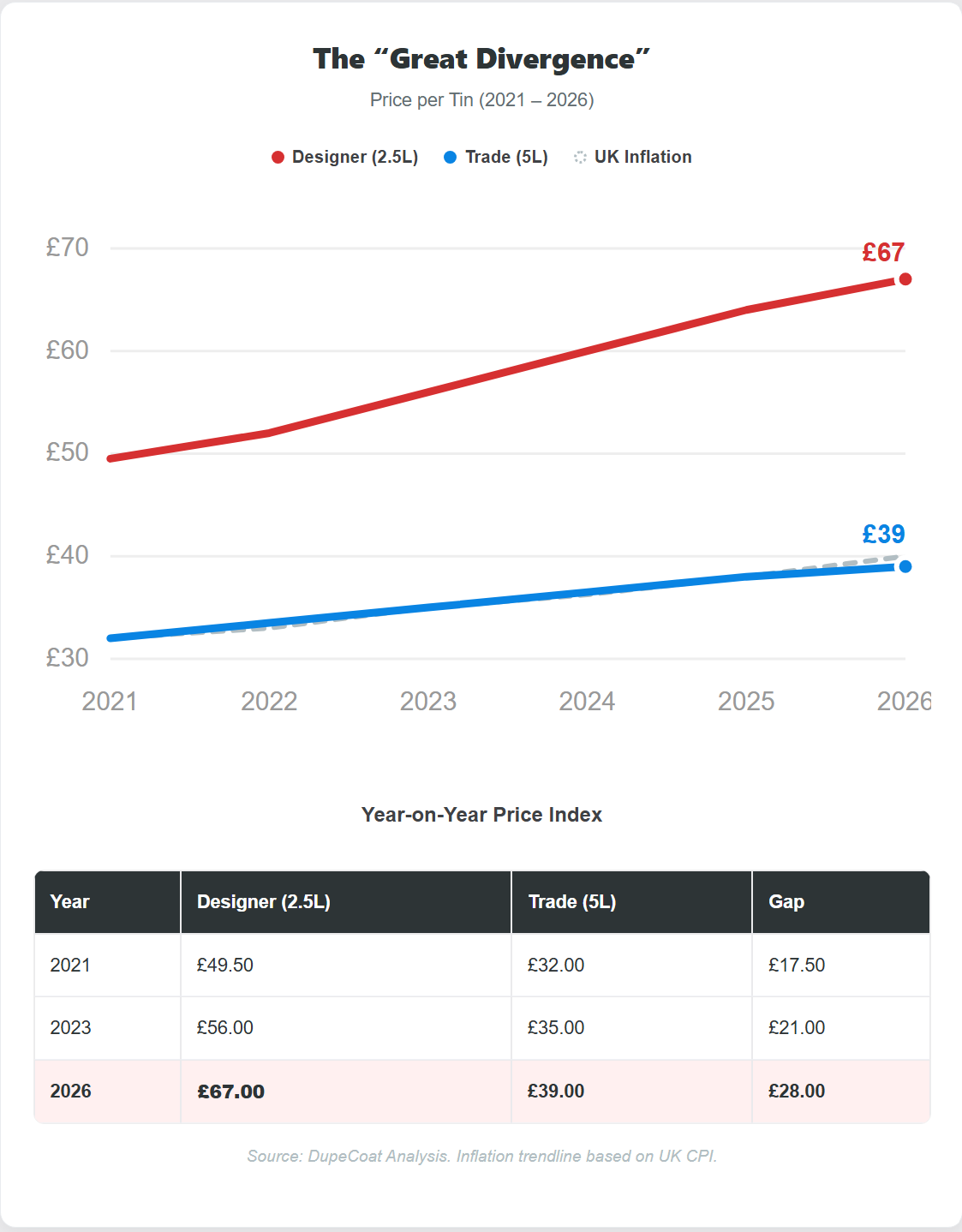
Since 2021, the cost of a standard 2.5L tin of premium designer emulsion has risen by approximately 35.3%. In contrast, high-quality trade paint (the kind used by professionals) has risen by roughly 21%, tracking closely with the Bank of England’s cumulative inflation figures for the same period.
This suggests that while trade manufacturers raised prices to cover raw material costs, designer brands may have raised prices simply because they could.
Visualizing the Price Hike
The graph below illustrates the widening gap between the “Aspirational” price tag and the “Professional” price tag.
The “Great Divergence”
Price per Tin (2021 – 2026)
| Year | Designer (2.5L) | Trade (5L) | Gap |
|---|---|---|---|
| 2021 | £49.50 | £32.00 | £17.50 |
| 2023 | £56.00 | £35.00 | £21.00 |
| 2026 | £67.00 | £39.00 | £28.00 |
Source: DupeCoat Analysis. Inflation trendline based on UK CPI.
Key Findings from the Index
- Designer Disconnect: In 2021, the price gap between a tin of Farrow & Ball (2.5L) and Johnstone’s Trade (5L) was roughly £17.50. In 2026, despite the trade tin containing double the paint, the price gap is largely the same, but the value proposition has shifted drastically.
- The £67 Ceiling: We have now breached the psychological barrier of £65 for a standard tin of retail paint.
- Trade Stability: Trade paint prices have remained relatively stable in real terms, suggesting that the “base cost” of making high-quality paint has not exploded—only the marketing costs have.
Why This Matters for Renovators
This data proves that the “smart money” is moving away from the label. When you buy a designer brand today, a larger percentage of your money is going towards the “Brand Premium” than it did five years ago.
By switching to a trade alternative using a service like DupeCoat, you aren’t just getting a cheaper product; you are opting out of an artificial price hike. You get the same colour (matched via NCS technology) and the same chemical durability, but you pay a price based on manufacturing cost, not marketing hype.
Conclusion Renovation is expensive enough in 2026 without paying a voluntary tax on your wall colour. The numbers don’t lie: Paint is chemistry, but pricing is psychology.